

Understanding Birthmark Removal in 2026
Birthmarks are common skin findings that can appear at birth or develop shortly after. While many birthmarks are harmless and purely cosmetic, others may change over time, affect confidence, or require medical evaluation.
In 2026, birthmark removal has advanced significantly, offering patients safer, more precise, and highly personalized treatment options.
Two main approaches dominate modern dermatology:
- Laser-based treatments
- Medical or procedural treatments
Understanding the difference between these options is essential to choosing the right solution for your skin, your birthmark type, and your long-term goals.
What Are Birthmarks? A Medical Overview
Birthmarks fall into two primary categories:
Pigmented Birthmarks
These are caused by excess melanin in the skin and include:
- Café-au-lait spots
- Congenital melanocytic nevi
- Mongolian spots
Vascular Birthmarks
These result from abnormal blood vessels and include:
- Port-wine stains
- Hemangiomas
- Salmon patches
The type, depth, size, and color of a birthmark determine whether laser therapy or medical procedures—or a combination of both—will provide the best outcome.
Laser Birthmark Removal: How It Works
Laser birthmark removal uses focused light energy to target pigment or blood vessels without damaging surrounding skin.
Common Laser Technologies Used in 2026
- Pulsed Dye Laser (PDL) for vascular birthmarks
- Q-Switched & Picosecond Lasers for pigmented birthmarks
- Nd:YAG Laser for deeper or resistant lesions
The laser breaks down pigment or collapses abnormal blood vessels, allowing the body to gradually clear them naturally.
Benefits of Laser Birthmark Removal
Laser treatment is often the first-line choice for many patients because it offers:
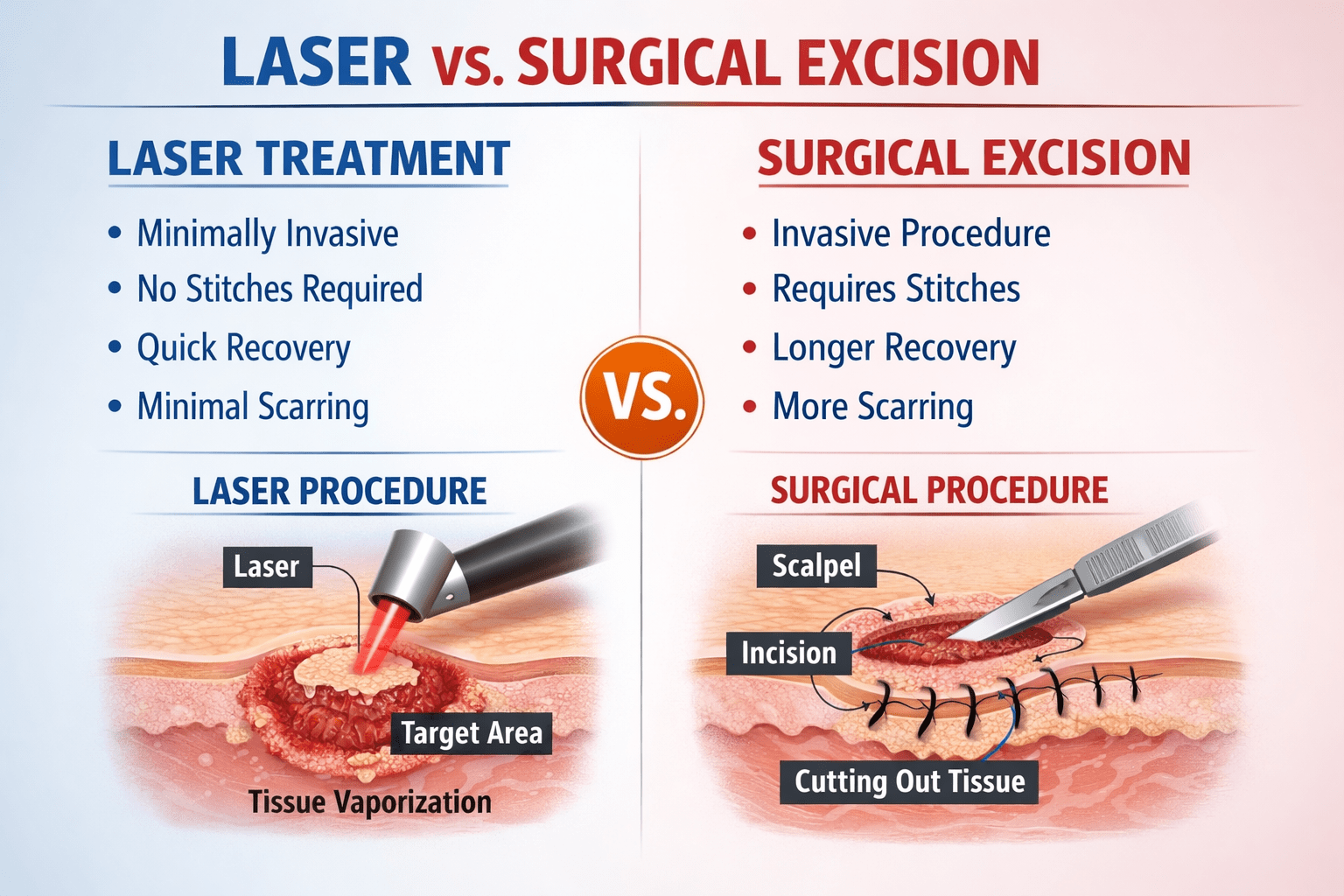
- Non-surgical, minimally invasive treatment
- No stitches or scarring when performed correctly
- Precise targeting of pigment or vessels
- Short recovery time
- Suitable for both children and adults
Advancements in 2026 allow lasers to be adjusted for different skin tones, significantly improving safety for darker skin types.
Limitations of Laser Treatment
While laser technology is powerful, it is not always the best option for every birthmark.
Laser treatment may be less effective if:
- The birthmark is very deep
- The lesion is thick or raised
- There is suspicion of malignant change
- The birthmark requires histological examination
In such cases, medical procedures may offer better control and diagnostic certainty.
Medical Procedures for Birthmark Removal Explained
Medical birthmark removal includes dermatological and surgical techniques such as:
- Surgical excision
- Shave removal
- Cryotherapy (in select cases)
- Medical monitoring with biopsy
These procedures are typically performed under local anesthesia by a qualified dermatologist or plastic surgeon.
When Medical Procedures Are Recommended
Medical procedures are preferred when:
- The birthmark has irregular borders or color changes
- There is concern about skin cancer risk
- The lesion is raised or thick
- Laser treatment would be ineffective
- Complete removal is medically necessary
In 2026, medical procedures are refined to minimize scarring and preserve natural skin texture.
Benefits of Medical Birthmark Removal
Medical procedures provide advantages that lasers cannot always offer:
- Complete physical removal of the lesion
- Ability to send tissue for biopsy
- One-time treatment in many cases
- Effective for deep or raised birthmarks
For certain congenital nevi, surgical removal remains the gold standard.
Laser vs Medical Procedures: A Side-by-Side Comparison
Factor | Laser Treatment | Medical Procedures |
Invasiveness | Non-invasive | Minimally invasive |
Downtime | Minimal | Moderate |
Scarring Risk | Very low | Low to moderate |
Best For | Flat, pigmented, vascular marks | Raised, deep, suspicious lesions |
Number of Sessions | Multiple | Often one |
Biopsy Possible | No | Yes |
Which Option Is Right for You?
Choosing between laser and medical procedures depends on several factors:
- Type of birthmark
- Skin tone and sensitivity
- Age of the patient
- Medical history
- Cosmetic expectations
In many cases, dermatologists combine laser therapy with medical procedures for optimal results.
Birthmark Removal for Children vs Adults
Early intervention can sometimes improve outcomes, especially for vascular birthmarks. However, modern technology allows safe treatment at almost any age.
A personalized consultation ensures:
- Age-appropriate techniques
- Minimal discomfort
Long-term skin safety
Safety and Results in 2026
With modern dermatology standards:
- Treatments are safer than ever
- Risk of scarring is significantly reduced
- Results appear more natural
- Skin healing is faster
The key to success lies in expert diagnosis and tailored treatment planning.
Why Professional Consultation Matters
Birthmark removal is not a cosmetic shortcut—it is a medical decision.
Self-treatment or unqualified providers increase the risk of scarring, pigmentation changes, or incomplete removal.
A specialist evaluates:
- Depth and structure of the lesion
- Skin type compatibility
- Long-term outcomes
Final Thoughts
Laser and medical procedures are both powerful tools in modern birthmark removal. The right choice depends on your unique skin condition—not trends or assumptions.
In 2026, the focus is no longer on “removal at any cost,” but on safe, precise, and personalized dermatology that respects skin health and natural appearance.
At Reveal Clinics, birthmark removal is guided by medical expertise, advanced technology, and individualized care—ensuring results that are both effective and responsible.
Because every birthmark tells a story—and modern dermatology knows how to treat it safely. Book your consultation